
Potluck Project
Meet The Teacher: Holly Isaac
Hi I'm Holly. I love teaching ceramics. I have been teaching clay for 10 years now. I have taught clay to k-12 graders. I love seeing how excited the kids get when they make something they can use.
Project Description
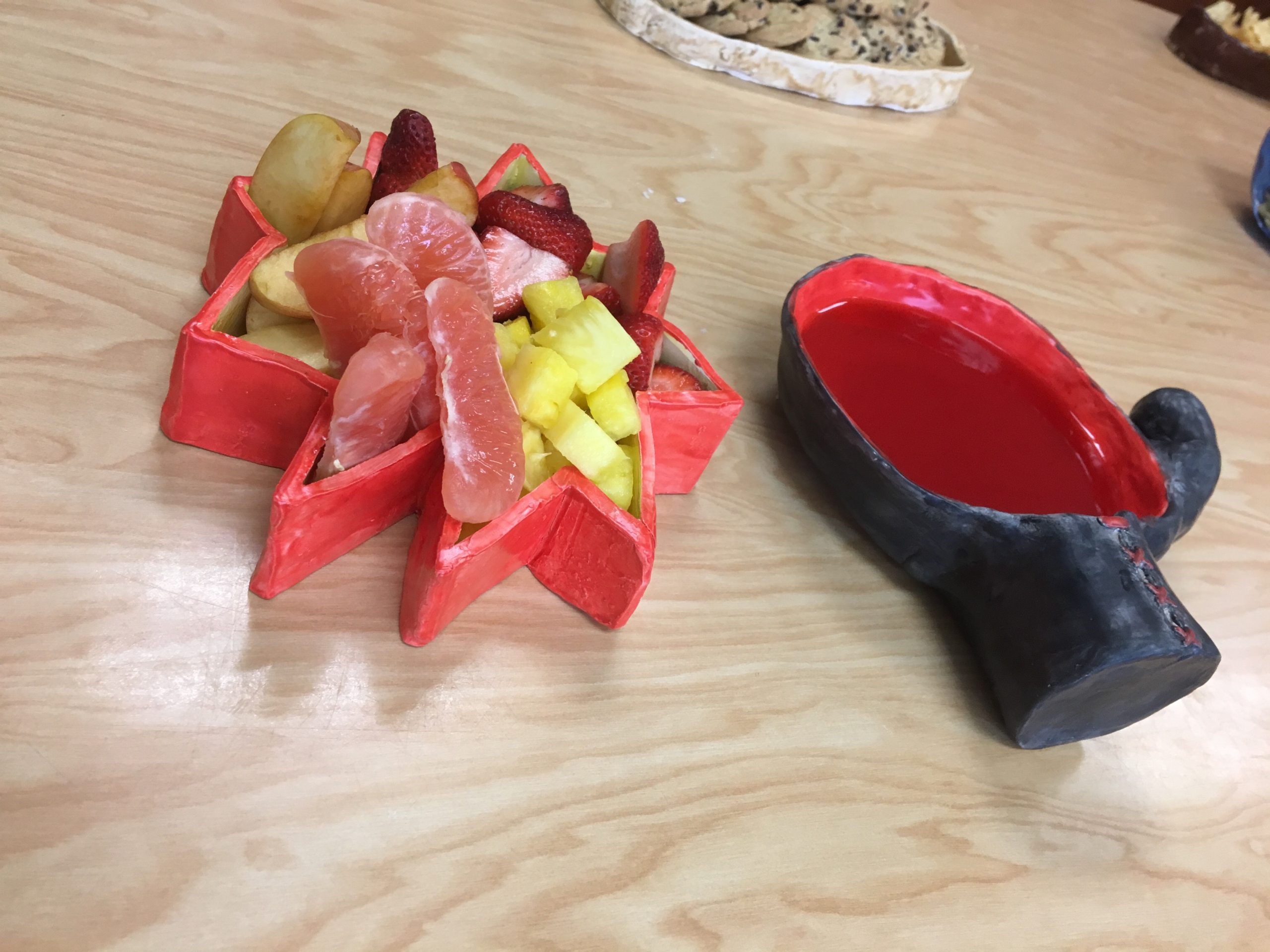
Students select a food and design a container, platter, or sculptural display intended for that food. It must be clear what food belongs in the container without directly sculpting the food itself. The piece should represent the food through form, texture, structure, or symbolism, rather than literal imagery.
Grade Level
High School
Difficulty
Intermediate
Student Hands-On Time
15 45-minute class periods
Teacher Prep Time
Loading kiln only
Project Cost / Cost Per Student
4.95
National Core Arts Standards - Visual Arts
- Creating - Generate and conceptualize artistic ideas.
- Creating - Organize and develop artistic work.
- Creating - Conceiving and developing new artistic ideas and work.
- Presenting - Select, analyze, and interpret works for presentation.
- Presenting - Develop skills for artistic presentation and exhibition.
- Responding - Perceive and analyze artistic work.
- Responding - Interpret intent and meaning in artwork.
- Responding - Evaluate and critique based on aesthetic and technical qualities.
- Connecting - Relate artistic ideas to historical, cultural, and social contexts.
- Connecting - Connect personal experiences with artmaking and meaning.
21st Century Skills
- Critical Thinking & Problem-Solving
- Creativity & Innovation
- Communication
- Social & Cross-Cultural Skills
STEAM Education
- Arts
Differentiations and Accommodations
Differentiation
IEP
Accommodation
Adjust craftsmanship expectations based on student skill level. Could use cookie cutters to help cut different base shapes. Could use bowl or plate to have them use as a mold for the clay.
Differentiation
504 Accommodations
Accommodation
Adjust craftsmanship expectations based on student skill level.
Differentiation
Advanced Learners
Accommodation
Push them to think more about word meaning for puns. Push them to create higher level craftsmanship project like a cake stand with gravity limitations.
Learning Objectives: Knowledge
Students will understand and analyze how artists use design principles, symbolism, and conceptual thinking to communicate meaning through functional or sculptural ceramic forms. Students will know:How design principles (emphasis, balance, contrast, repetition, proportion, movement, negative space) influence three-dimensional composition.How artists use metaphor, symbolism, and humor to communicate ideas visually.The relationship between form and function in ceramic design.How hand-building techniques (pinch, coil, slab) can be combined to construct complex ceramic forms.
Learning Objectives: Skills
Students will apply artistic processes and technical skills to develop and construct a ceramic sculpture/container that communicates a conceptual relationship to food.Students will be able to:Generate and revise ideas through brainstorming, research, and sketching.Apply design principles to organize three-dimensional compositions.Construct a stable ceramic form using pinch, coil, and slab techniques.Solve structural and visual problems independently while working with clay.Refine craftsmanship and surface details to strengthen the conceptual message of the work.
Learning Objectives: Attitudes/Values
Students will develop appreciation for conceptual thinking in art and demonstrate persistence, independence, and openness to creative risk-taking.Students will value:The importance of creative exploration and idea development in the artistic process.Originality and personal voice when developing artistic concepts.The role of problem-solving and experimentation in creating successful artwork.Respect for craftsmanship, patience, and persistence when working with ceramic materials.Practice presenting and evaluating their artwork and conveying the message they intended.
Formative Assessment
Idea research Progress checks
Summative Assessment
Project built Project with Glaze Critique day and reflection questions
Reflection and Discussion
Exploration & Process:How did your brainstorming, research, and sketching influence your final design, and what revisions did you make along the way to strengthen your idea? Creativity & Conceptual Development1:In what ways does your sculpture/container communicate a unique and personal interpretation of the food without being literal, and how does your concept go beyond the obvious? Critical Thinking:What problems did you encounter during this project, and how did you evaluate possible solutions before deciding on your final approach? Technique & Skill Development:How did your use of pinch, coil, and slab techniques contribute to both the structural success and visual impact of your piece? What technical choices are you most proud of? Project Execution & Artistic Independence:How does your finished work demonstrate care, craftsmanship, and self-direction, and what decisions show your growth as an independent artist?
Lesson Activities
Project Planning
Introduce the project and multiple ideas. Look together at examples and brainstorm ideas for puns. Discuss recipes and culture. How can students pull inspiration from their family meals, holiday traditions, and special recipes to create something special? Think of 70’s soup bowl with recipe on it, cookie jars, cake stands, taco holders.
Work days
Show example on the board. Have reminders: Have a solid plan for what your potluck project is going to be.
Critique Day
have the students bring in the food that goes with their project. Have them answer the reflection questions before. Go around to each student. Have the presenter tell the audience a little bit about their project. Ask the audience one positive and one constructive criticism. Go around the whole room.
Follow Us:


