
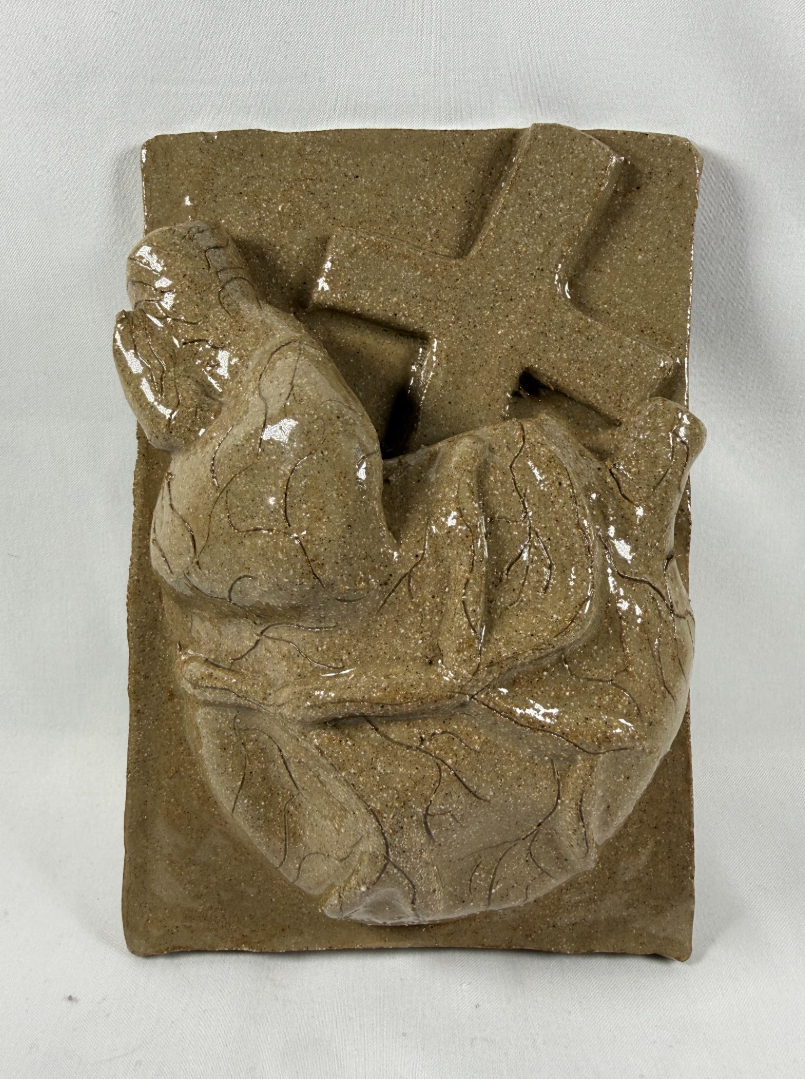
Sculptural vs. Functional – Ceramic Wall Hangings
Meet The Teacher: Caylie Riess
Caylie Riess is a K–12 certified Visual Arts teacher at Hamilton High School, Michigan. She fosters hands-on learning, creativity, and problem-solving while helping students explore their artistic voice and understand art in historical and cultural contexts.
Project Description
Inspired by Riess’ ceramic wall sculptures, students create personal ceramic wall hangings using prior techniques, exploring functional vs. sculptural ceramics, materials, glazes, and art history while engaging in ideation, planning, and construction to develop individual concepts. Then, students are guided through reflection and peer connection.
Materials
- Low or high fire clay
- Glazes needed for the clay body
- Various ceramic tools
- Kiln
Grade Level
High School
Difficulty
Intermediate
Student Hands-On Time
1 hour classes/5 days per week for 1-1.5 weeks depending on the detail of student work.
Teacher Prep Time
About one hour to research content in slides so you are prepared to present the topic and knowledge of different hand building techniques
Project Cost / Cost Per Student
5
National Core Arts Standards - Visual Arts
- Creating - Generate and conceptualize artistic ideas.
- Creating - Organize and develop artistic work.
- Creating - Conceiving and developing new artistic ideas and work.
- Presenting - Select, analyze, and interpret works for presentation.
- Presenting - Develop skills for artistic presentation and exhibition.
- Responding - Perceive and analyze artistic work.
- Responding - Interpret intent and meaning in artwork.
- Responding - Evaluate and critique based on aesthetic and technical qualities.
- Connecting - Relate artistic ideas to historical, cultural, and social contexts.
- Connecting - Connect personal experiences with artmaking and meaning.
21st Century Skills
- Critical Thinking & Problem-Solving
- Creativity & Innovation
- Communication
- Media Literacy
- Flexibility & Adaptability
- Initiative & Self-Direction
- Social & Cross-Cultural Skills
- Productivity & Accountability
- Leadership & Responsibility
STEAM Education
- Arts
Differentiations and Accommodations
Differentiation
Advanced Learners
Accommodation
Encourage students to go bigger or to create sets of wall hangings.
Differentiation
Struggling Learners
Accommodation
Frequent check ins. Offering ways to par back their idea while still meeting their goals.
Differentiation
IEP
Accommodation
Break down the project into smaller steps, with a heavier focus on creating. Check in to help them formulate hand-building methods for their design. Can complete reflection verbally.
Differentiation
504 Accommodations
Accommodation
Extended project work time if needed. Point them in the direction of the visuals posted or packet given for hand-building techniques. Additional help with hanging hook placement.
Learning Objectives: Knowledge
By the end of the lesson, students should be able to show their understanding of sculptural vs functional work. They should use their prior knowledge to expertly attach and assemble their piece according to the plan they make. Students will be able to connect ceramic wall art across time. Students will show their knowledge of clay bodies and glaze application. Students should know how to devise a plan using the creative process and include a way to hang their work then reflect and build an artist statement.
Learning Objectives: Skills
Students will gain skills that will be present in problem solving and showing their autonomy in the clay studio and creative processes. Students will learn how they can display their clay on a wall instead of on a flat surface like a bookshelf or display case. Students will be able to connect previous content learned about ceramic tiles and relief to contemporary artists.
Learning Objectives: Attitudes/Values
Our school’s four pillars respect, responsibility, grit, empathy. This is expected in the studio. Student work is made from their own hands and inspiration. Student work employs proper building techniques. Students should keep an open and curious mind when viewing contemporary art from artists of different backgrounds.
Formative Assessment
Functional vs. sculptural knowledge on hands Planning/Sketch Sheet Check in Mid-Point Critique with table partners
Summative Assessment
Functional vs. sculptural knowledge test (optional) Test about Frimpong (optional) Planning/Sketch Sheet Turn in for completion and meet with students Final Product Reflection of the process Peer review
Reflection and Discussion
Think about the inspiration your piece is coming from. What can you see from other contemporary artists' works that are reflected here? How did the artist decide to hang their item? Is your peer meeting the expectations of the assignment i.e. proper hand-building techniques, score/slip/stick/smooth, hanger in the back.Peer and teacher feedback during planning stages. Mid-point creating critique with table group. Artist statement/reflection on their piece. Peer review of a student's work.
Lesson Activities
SlideShow- Explore Sculptural vs. Functional Ceramic Work
Students will learn or be refreshed on sculptural vs. functional work. The teacher will formatively assess their learning with each picture by asking them to show a number on their hands. i.e. one finger for sculptural two fingers for functional. Teacher will call on students to explain their reasoning.
Sculptural vs. Functional Test (Optional)
The teacher can give a summative assessment to see if students know the difference between the two forms of pottery. I use Canvas, where I will usually insert a couple of photos of ceramic work and ask students to choose and explain their reasoning.
SlideShow- Introduction to wall installations using ceramic
Students pull on past examples from the class of ceramic works they have learned that are displayed on walls. I usually test their knowledge first before giving them refreshers on relief and tile work. I then talk about various artists, some are not ceramic artists, about wall installations. We discuss contemporary artists with VTS strategies being used when viewing Vincent Frimpong's work.
Slideshow- Wall Hangings
We do a little research about how to hang ceramic work and see what we can come up with as a class.
SlideShow- Introduce Wall Hanging as a project and discuss teacher's work
Here, we talk about different themes students can use for inspiration on their wall hanging. I also discuss my personal work and experience with wall installations in ceramic work and describe my inspiration for the project. I also talk about how a nail we used to install these was not strong enough to support the weight of my work (and how their project will need to be balanced) and it shattered. "The only thing certain in ceramics is that nothing is certain." A quote from my mentor Lisa Rilley.
Planning/Sketching
Students will develop a plan for their work. Starting with three thumbnail sketches. From there, they will write down their plan to create their object, describing the handbuilding techniques and glazes they will choose as well as their method for hanging their item. Students MUST get peer feedback from two students in the classroom and the teacher. Students must write down feedback.
Creating/ Revising/ Problem Solving/ Mid-Crit
Students will start to build. The teacher is there to help them work through problems if needed and help them to work on advanced building techniques. Students submit the work to be fired with underglaze, depending on their clay body type. Teacher also checks in with sketch sheets giving feedback. Mid-Point Critique with peers.
Firing Process
The teacher works through the firing process, getting work back and making sure the glaze is applied properly. Some students might need a second firing.
Artist Statement
After work is complete students must reflect on their process and art making.
Peer Review and Response
Gallery walk with statements put out. Students must respond in writing to at least one student.
Step-by-Step Instructions
Step 1
View the slide show, have group discussions, student research, explain project overview.
Step 2
Plan your project and get two students and the teacher to peer review it. Talk through the process of how you will make it.
Step 3
Create with intention and proper hand-building techniques. Mid-Point crituque with table group.
Step 4
Fire project and refire after glaze applications if necessary.
Step 5
Artist Statement and gallery walk with peer review.
Follow Us:


