
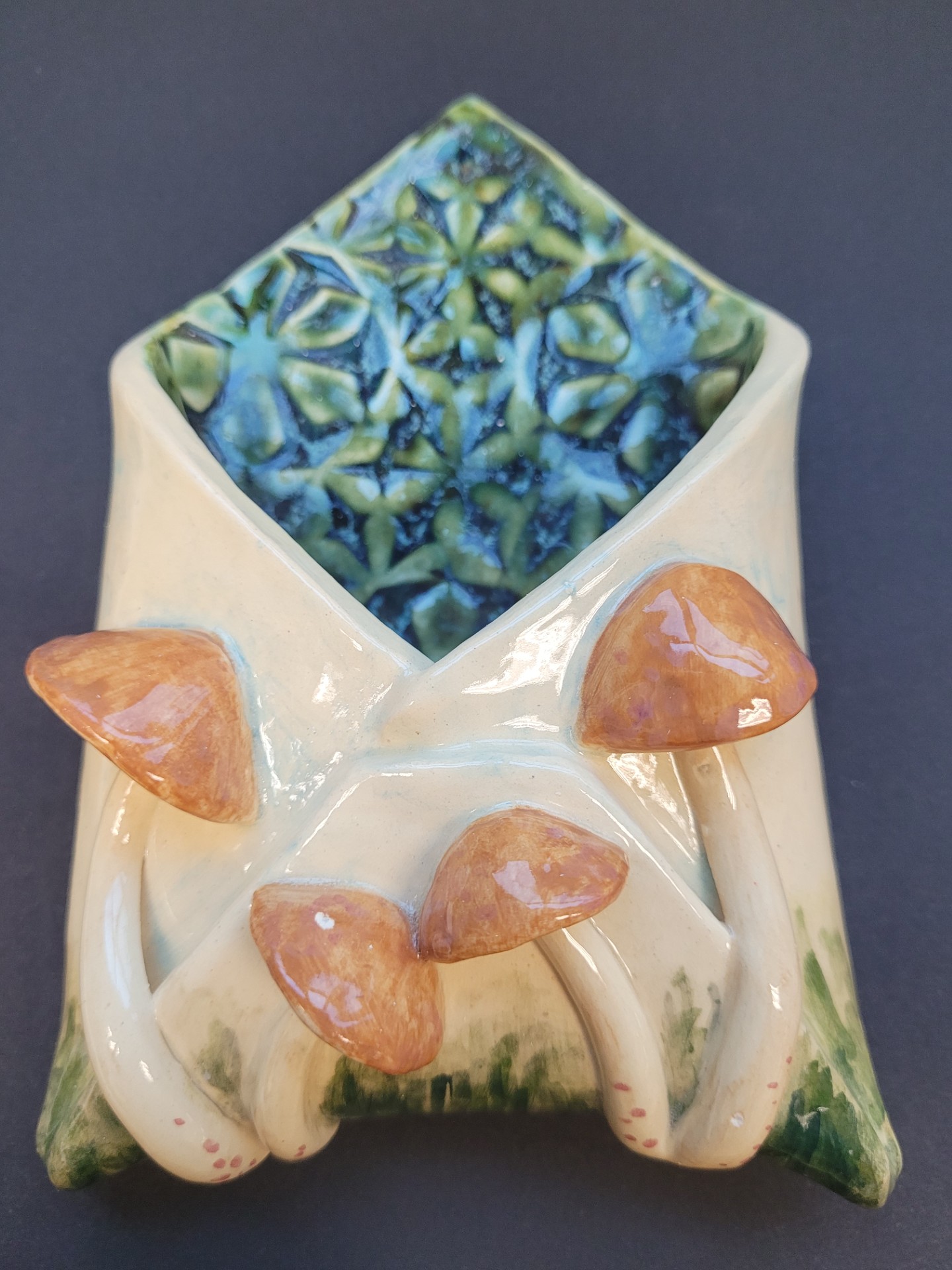
Environmental Envelopes
Meet The Teacher: Jennifer LaScala
I teach ceramics at Sayreville War Memorial High School in Parlin, NJ. This is my 22nd year teaching there. I also am the director of Clay in Mind, a juried high school ceramic competition for the state of NJ.
Project Description
Students create ceramic envelopes by using a basic sqaure pattern, rolling out a slab of clay, constructing the envelope together, and adding details of environmental items of their choice.
Materials
- Clay, glazes, tools, 5 x 5, or 7 x 7 cardboard template, textural items
Grade Level
High School
Difficulty
Easy
Student Hands-On Time
1 week
Teacher Prep Time
10 minutes
Project Cost / Cost Per Student
5
National Core Arts Standards - Visual Arts
- Creating - Generate and conceptualize artistic ideas.
- Creating - Organize and develop artistic work.
- Presenting - Develop skills for artistic presentation and exhibition.
- Responding - Interpret intent and meaning in artwork.
- Responding - Evaluate and critique based on aesthetic and technical qualities.
- Connecting - Relate artistic ideas to historical, cultural, and social contexts.
- Connecting - Connect personal experiences with artmaking and meaning.
21st Century Skills
- Critical Thinking & Problem-Solving
- Creativity & Innovation
- Communication
- Flexibility & Adaptability
- Initiative & Self-Direction
- Productivity & Accountability
- Leadership & Responsibility
STEAM Education
- Science
- Arts
Differentiations and Accommodations
Differentiation
IEP
Accommodation
Students are allowed extra time to work on projects. Teacher also provides individual demosntration and resource videos to students
Learning Objectives: Knowledge
Students should be able to:
- Properly roll out an even thickness slab of clay
- Properly score, slip and secure their details
- Successful work with soft slabs
- Utilize a variety of textures to create different types of environmental items/spaces
- Incorporate sculpted details into their work that enhance their environmental theme
Learning Objectives: Skills
This is a Ceramic 1 project. Most students have little, to no experience in workign with clay. Students shoul dhave basic skills such as wedging clay, scoring, slipping and securing, ways to create texture ( carving/stamping/imprinting/additive) and basic sculpting skills.Basic knowledge of glaze application and layering of glaze colors is also useful.
Learning Objectives: Attitudes/Values
Project Objectives ( Expectations)
- Properly roll out an even thickness slab of clay
- Incorporate texture onto their project
- Properly construct clay envelope together
- Properly score, slip and secure their details
- Successful work with soft slabs
- Utilize a variety of textures to create different types of environmental items/spaces
- Incorporate sculpted details into their work that enhance their environmental theme
- Utilize glaze to enhance ceramic piece
Formative Assessment
It's important to circulate the room while students are working, Physically seeing them work, and how they go about usign tools, and technqiues, greatly helps their overall success in projects.
Summative Assessment
Once students are finished with their projects, they complete a project rubric, evaluating their own artwork, noting strengths and areas that still need improvement. Teacher alsoprovides constructive feedback on all student work.
Reflection and Discussion
Class Critique and discussion is very important. After students complete their self evaluation, and teacher has provided feedback on all individual work, students get to talk about work as a class. All projects are put in the center of the table and given a number. Students are given post it notes and can place those notes next to any 2 works of their choice. They must list 1 thing that love about the piece and 1 thing the artist can work on. All works must have post its by them, so if one piece already has a few, chose another piece to comment on. Students get to keep post it comments of their pieces
Lesson Activities
Environmental Envelope
Students will select an environment of their choice. This can include a specific place or a habitat, or utilization of natural elements. Students will work on design sketches, creating ideas of ways to incoporate texture that will complement their choise environment in addition to the sculpted details they will be attaching onto their envelops. Students will then work with soft slabs and a basic square pattern ( 5 x 5, or 7 x 7) to create their envelope shape.
Step-by-Step Instructions
Step 1
Day 1: Show students previous examples of the project. Discuss project expectations. Talk about different types of environments, and other natural elements/items. Have students generate a list in their sketchbooks of possible environment themes. Two final design sketches are required. Sketches must include possible textures, sculpted items, and teacher should be able to recognize chosen environment theme. Day 2: Demo day. Teacher demonstrate how to properly roll out a slab of clay. Explain the difference between soft slabs and leather-hard slab construction. Demonstrate how to properly put the clay envelope together using the 5 x 5 square patter or 7 x 7 square pattern. Students will start with clay to create their envelope Day 3-7: Students work with clay in creating their detailsAllow projects to fully dry, then fire, then students select their glaze colors and glaze.
Follow Us:


