
Art Activism and Endangered Animals
Meet The Teacher: Julia Jahr
I have my Bachelors of Arts from Rutgers University and MA in Education from The College of New Jersey. I have been teaching art and ceramics at Northern Burlington County Regional High School for 15 years. For two years I was the coordinator of the New Jersey clay competition, Clay In Mind.
Project Description
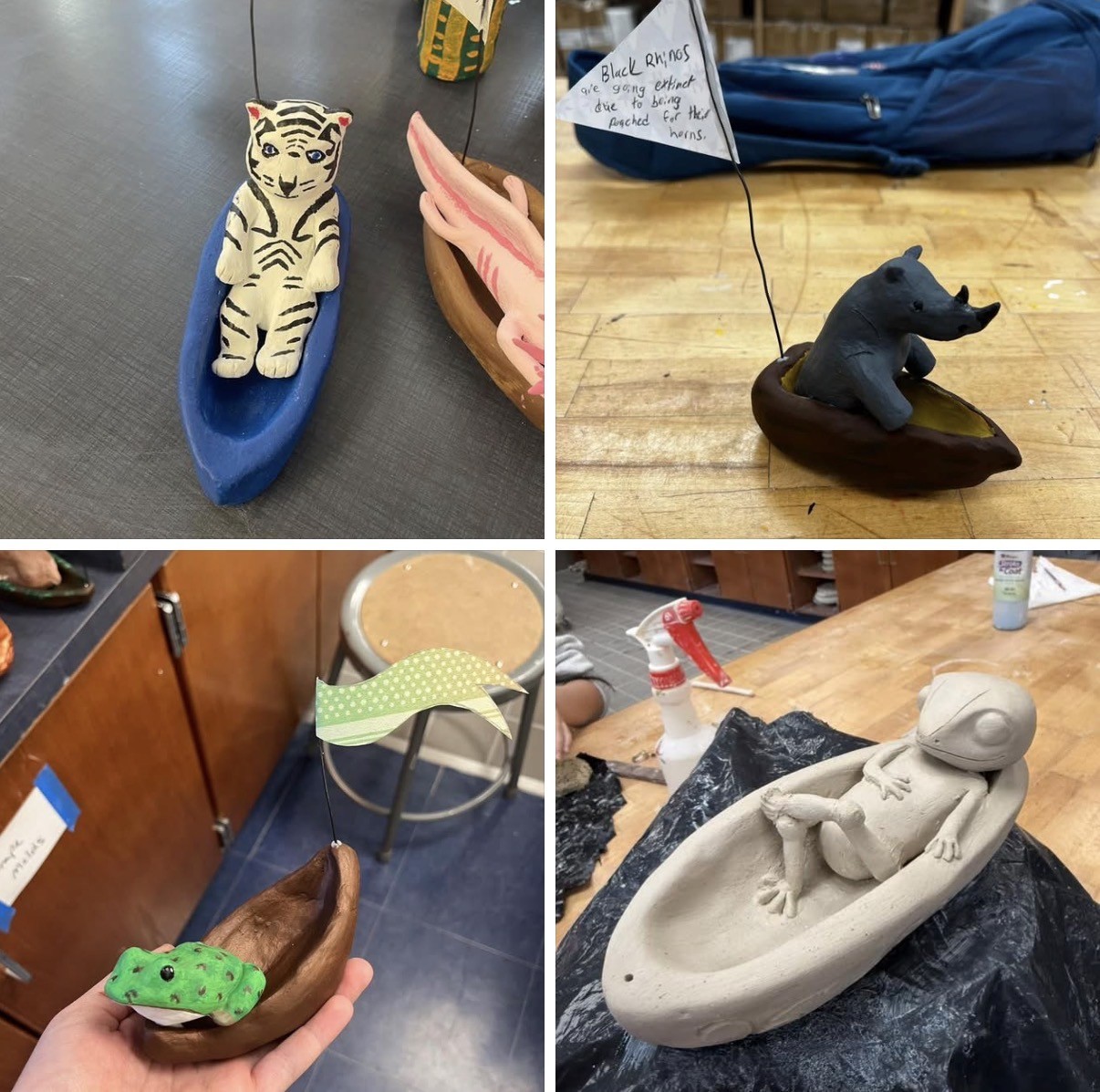
Students research an endangered animal. Once their animal is chosen, they make that animal out of clay and place it in a clay boat. In the back of the boat there is a flag with that animal's interesting fact. Once all of the projects are completed, they are set up in an installation in the school where everyone can see them and read about them.
Grade Level
High School
Difficulty
Intermediate
Student Hands-On Time
6 hours
Teacher Prep Time
2 hours
Project Cost / Cost Per Student
5
National Core Arts Standards - Visual Arts
- Creating - Generate and conceptualize artistic ideas.
- Creating - Organize and develop artistic work.
- Presenting - Develop skills for artistic presentation and exhibition.
- Responding - Interpret intent and meaning in artwork.
- Connecting - Connect personal experiences with artmaking and meaning.
STEAM Education
- Science
- Arts
Differentiations and Accommodations
Differentiation
Struggling Learners
Accommodation
Students can create a cartoon like animal if they struggle making their animals look realistic.
Differentiation
IEP
Accommodation
Students can create a cartoon like animal if they struggle making their animals look realistic. Give extended time to work on their project if needed.
Differentiation
504 Accommodations
Accommodation
Students can create a cartoon like animal if they struggle making their animals look realistic. Give extended time to work on their project if needed.
Differentiation
Advanced Learners
Accommodation
Have students create two animals in their boat for someone that is advanced.
Learning Objectives: Knowledge
Students will learn about endangered animals and art activism. By putting together a collection of art and showing it to an audience, they can help to bring awareness to certain causes.
Learning Objectives: Skills
Students will learn about proportion, how to wedge clay, and how to attach pieces of clay together by slipping and scoring.
Learning Objectives: Attitudes/Values
Students learn about endangered animals and how to proportionally make them. During this process they learn patience and how to use the proper tools to help their craftsmanship while working with clay.
Formative Assessment
Check understanding along the way to see that students are wedging clay properly, making their animals to proportion, and slipping and scoring their projects.
Summative Assessment
Students will be graded on the accuracy of their animals and the completeness of their boat with their flag attached.
Reflection and Discussion
Have students form groups to discuss their endangered animals. Have them make a KWL chart about their animal. (What they know, what they want to know, and what they learned after doing their research.) When all of the animals are displayed together, have students critique the display as a whole.
Lesson Activities
Researching and sketching an endangered animal
Students spend time researching their animal and sketching it out. Depending on the type of animal and size, they will need to see how it will fit in or around their clay boat. A sketch will be completed of their animal and their interesting fact about their endangered animal will be chosen.
Practice proportion
Students will receive an piece of clay the size of an orange. Together, all of the students will create a cat head. First they will round out their clay, next create the nose, mouth, and eyes. Lastly they will make the ears and add in additional details. This will teach students the steps in making the face of an animal and the techniques in building up structure and making eyes. In the beginning their animal doesn't look real, but with doing these steps they learn patience and can build the confidence in making an animal head. These techniques will be similar to when they make their own unique animal individually.
Building their boat
Students will learn the importance of wedging clay and the four main reasons why we wedge. One is to get rid of air bubbles, two is to take out excess moisture, three is to compress clay particles, and fourth is to even out the consistency in the clay. Once the clay is wedged, they form it into the shape of a sweet potato. Once this is done, they flatten it on the table to make one side flat. The side that is flat will be carved out so the boat is hollow. After it is hollowed out to 1/4 of an inch, the bottom is tapped on the table so it doesn't roll around. A pin tool hole is added into the back so wire can be placed in to hold the flag.
Creating their animal
Students will have a life like photo of their animal printed out or on their computer ready to view. The body of their animals will be created first. Next the heads, legs, arms and tail. We work from the largest section of the animal first to the smallest. After the pieces are made they are attached together, smoothed or texture is added and then the animal is attached in the boat. Boats are dried and bisque fired.
Painting the animals
Students can use underglaze or acrylic paint for their animal project. If underglazes are used, they will need to be fired once more. To save a firing, students can use acrylic paint and color match the paints to make their animals look realistic.
Create your flag with wire and paper
By using a wire and paper, students will cut the wire and write on the paper the interesting fact about their animal. Glue will be added to the end of the wire so the flag can be secured. Cut the paper into the desired shape/size of their flag. Glue can also be placed in the hole in the back of the boat so that the flag doesn't come out.
Display the endangered animals
Use a large table area to display all of the animals together so that viewers can see how many different animals there are that are endangered. Viewers can also read about the animals by seeing the flags attached in the back with their interesting facts on them.
Follow Us:


