
Shop

Build a Ceramic Kiln
Determine Capacity Needed
First, you need to find
out if the chamber of the kiln will be large enough to fire the pieces
you produce. The chart below lists the chamber sizes for each model.
The 3 things to consider when choosing the necessary chamber size are:
 What are the dimensions of the largest piece you will want to fire?
What is the
maximum volume of material that you will need to produce in a specific
time frame?
How do feel
your needs will grow in the next 5 years?
Use the following image as a reference for dimensions:
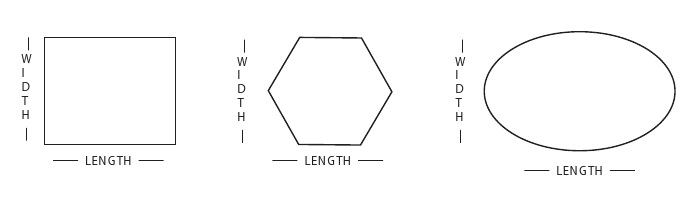
Kiln Chamber Dimension
What is the smallest acceptable chamber width:
11.00"14.00"15.00"17.00"18.00"22.00"23.00"28.00"40.00"46.00"
What is the smallest acceptable chamber length:
11.00"14.00"15.00"17.00"18.00"22.00"23.00"28.00"31.00"
What is the smallest acceptable chamber depth:
9"13.5"18"22"27"31"
Determine Your Available Power Supply
The next step is to find a kiln that will operate on the electrical service
of your building. Ordering a kiln that does not match your electrical service
can be very frustrating and expensive to correct.
Most people will need to have an electrician install the wire from the circuit
breaker panel to the wall receptacle as well as the receptacle. It is also
wise to have the electrician verify voltage, amperage and phase when he visits
on-site to estimate the job.
Learn More About Voltage. Click
Here
Learn More About Amperage. Click Here
Learn More About Phase. Click
Here
Refer to the Refined List to make sure the parameters you are selecting in the current step are possible
I want my kiln wired for the following voltage :
240 Volts 208 Volts 120/208-240 Volts 115 VoltsMy maximum amperage available for a new dedicated breaker is:
30 Amps 40 Amps 50 Amps 60 Amps 70 Amps 80 Amps 90 Amps 100 AmpsI have these power supply phases available:
1 3 1 and 3Determine the Firing Temperature Needed
Now we need to find a kiln that will fire to a temperature that meets, and preferably exceeds, the temperature requirements of the materials you will be working with.
Kilns are designed to fire to a variety of temperature ranges. Materials such as porcelain and stoneware require the kiln to reach temperatures up to Cone 10 (2350 F) and materials such as glass only require the kiln to reach less then 1600 F. Whenever possible you should choose a kiln that exceeds your firing temperature needs. The use of 3" brick, the voltage and the phase of a kiln model can sometimes affect its maximum rating. If you are firing regularly to Cone 6 (2250 F) or above, we highly suggest you buy a kiln that is rated to Cone 10 (2350 F). Production Kilns, referred to as "PK" kilns, are specifically designed for the high fire production studio.
What is the maximum firing temp you need?
2100 F 2185 F 2250 F 2300 F 2350 FChoose a Controller
"KM" represents KilnMaster Automatic ControllerKilnMaster Controllers were introduced in 1993 and have become the overwhelming choice of most ceramic artists. Click here for more information.
KilnMaster Controller
The KilnMaster Controller was introduced in 1993. There are two types of Kilnmaster controllers, the standard 24 key KilnMaster controller and the 3 button KilnMaster LT. Both controllers offer the user the ability to either design their own programs or simply enter the preheat time, cone value, desired speed and hold time and have the controller write the program for them. With the KilnMaster LT the information to enter is accessed by using up and down arrows and then selecting the desired value with an ENTER key. The larger KilnMaster controller uses a 24 key interface that is faster to program and offers more features. The KilnMaster LT (KMLT) is only available on the Firebox 8x6 and FireBox 8x4 Models.
Would you like a KilnMaster or KilnMaster Touch
KM (KilnMaster) KMT (KilnMaster Touch)Follow Us:


