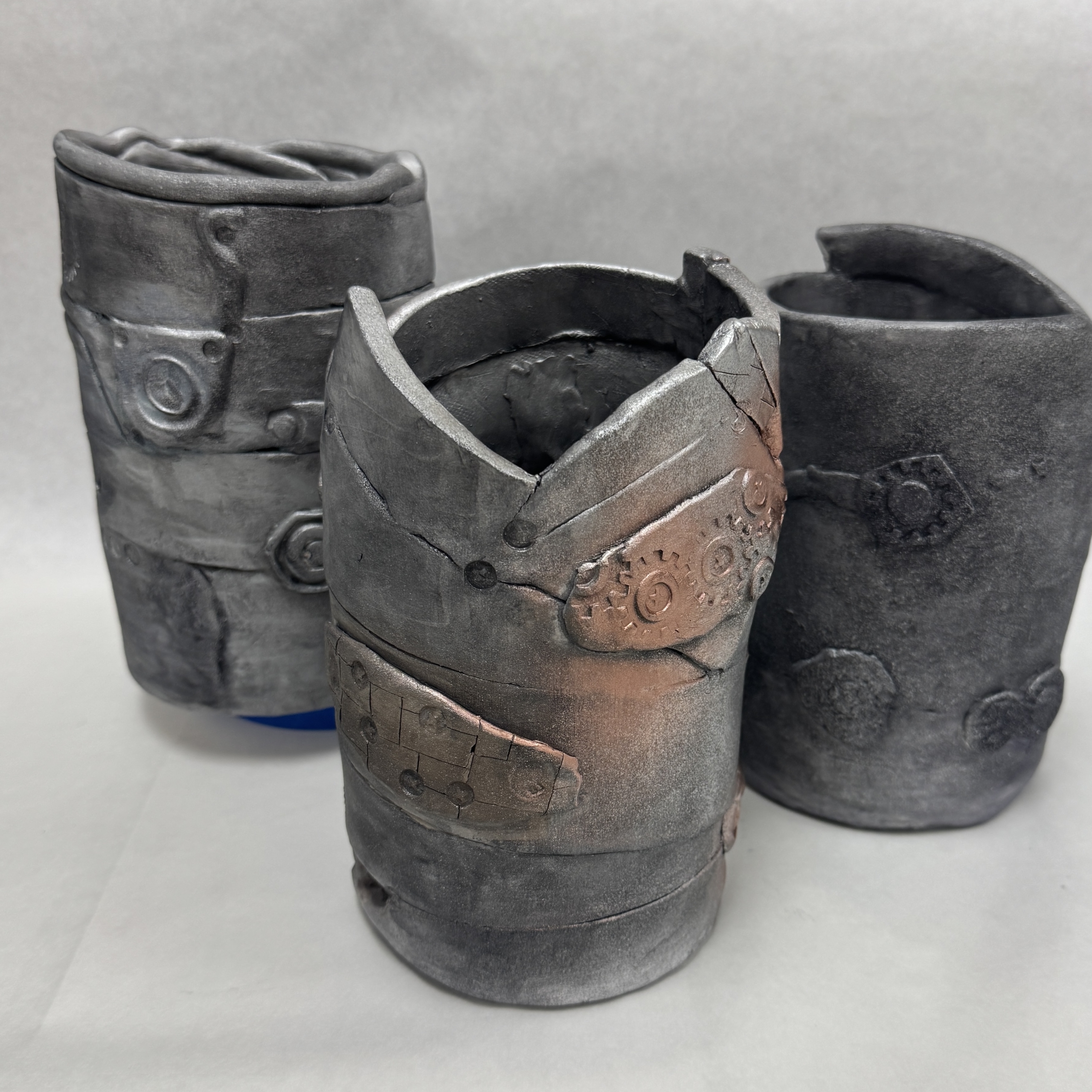
Steam Punk Vessel
Meet The Teacher: Michelle Zimmerman
I teach art at Davison Alternative where the students are at risk of not graduating with their high school class and create pottery in my free time. When students ask why they cannot do more pottery projects, I honestly tell them because our school does not have a kiln. I currently transport student work to other buildings if there is kiln space.
Project Description
Embrace imperfection while teaching slab building techniques using repurposed materials. Students wrap (or drape) a form with strips of rolled out clay then, stamp industrial textures and patterns using old hardware, chains, gears, and miscellaneous tool bench items. A cold finish is applied with paint after bisque firing.
Materials
- Clay- 2 Lbs., Slip, Rolling pin (dowels or sturdy tubes), Wooden rolling guide sticks, Scoring tool, Cloth or Masonite surface to roll upon, Form (recycled container), Hardware, rivets, and gears for stamping textures, Cornstarch (optional), 2 Plastic grocery bags for storage (names written using a sharpie), Water (spray bottle),
- Hardware, rivets, and gears for stamping textures Cornstarch (optional)
- 1-2 colors of metallic watercolor paint (any kind), Paintbrush, Sponge, Spray paint (optional clear coat, or metallic).
Grade Level
High School
Difficulty
Easy
Student Hands-On Time
5-50 minute class periods
Teacher Prep Time
20 Minutes
National Core Arts Standards - Visual Arts
- Creating - Generate and conceptualize artistic ideas.
- Creating - Conceiving and developing new artistic ideas and work.
- Responding - Perceive and analyze artistic work.
- Connecting - Relate artistic ideas to historical, cultural, and social contexts.
- Connecting - Connect personal experiences with artmaking and meaning.
21st Century Skills
- Critical Thinking & Problem-Solving
- Creativity & Innovation
- Media Literacy
- Flexibility & Adaptability
- Initiative & Self-Direction
- Social & Cross-Cultural Skills
- Productivity & Accountability
STEAM Education
- Science
- Technology
- Arts
- Mathematics
Differentiations and Accommodations
Differentiation
IEP
Accommodation
Learning Objectives: Knowledge
How to make a functional hand built container using slab construction methods that is inspired by the “Steam Punk Style.” a multi-step process that develops technical skill.
Learning Objectives: Skills
Prepping and using forms for wrapping and/or draping clay Rolling out clay evenly Join pieces securely using the “score, slip, attach and smooth” method. Applying surface design and texture patterns with additive and subtractive methods. Adding a base or foot to a container. Identifying the stages of clay in real time Storing clay work properly. Clay Wedging Clay Reclaiming Studio safety procedures Paint application methods (i.e. brush, sponge, wiping, and optional spray paint safety).
Learning Objectives: Attitudes/Values
Engage and persist in a world where instant gratification is rampant; ceramics cannot be rushed. Fine motor skill development through self-expression Artistic journey- Mistakes are necessary part of the and imperfection can be aesthetically pleasing. Sustainability- Recycled and found objects can be used creatively; art does not have to be costly.
Lesson Activities
Building Background in Art and Cultural History
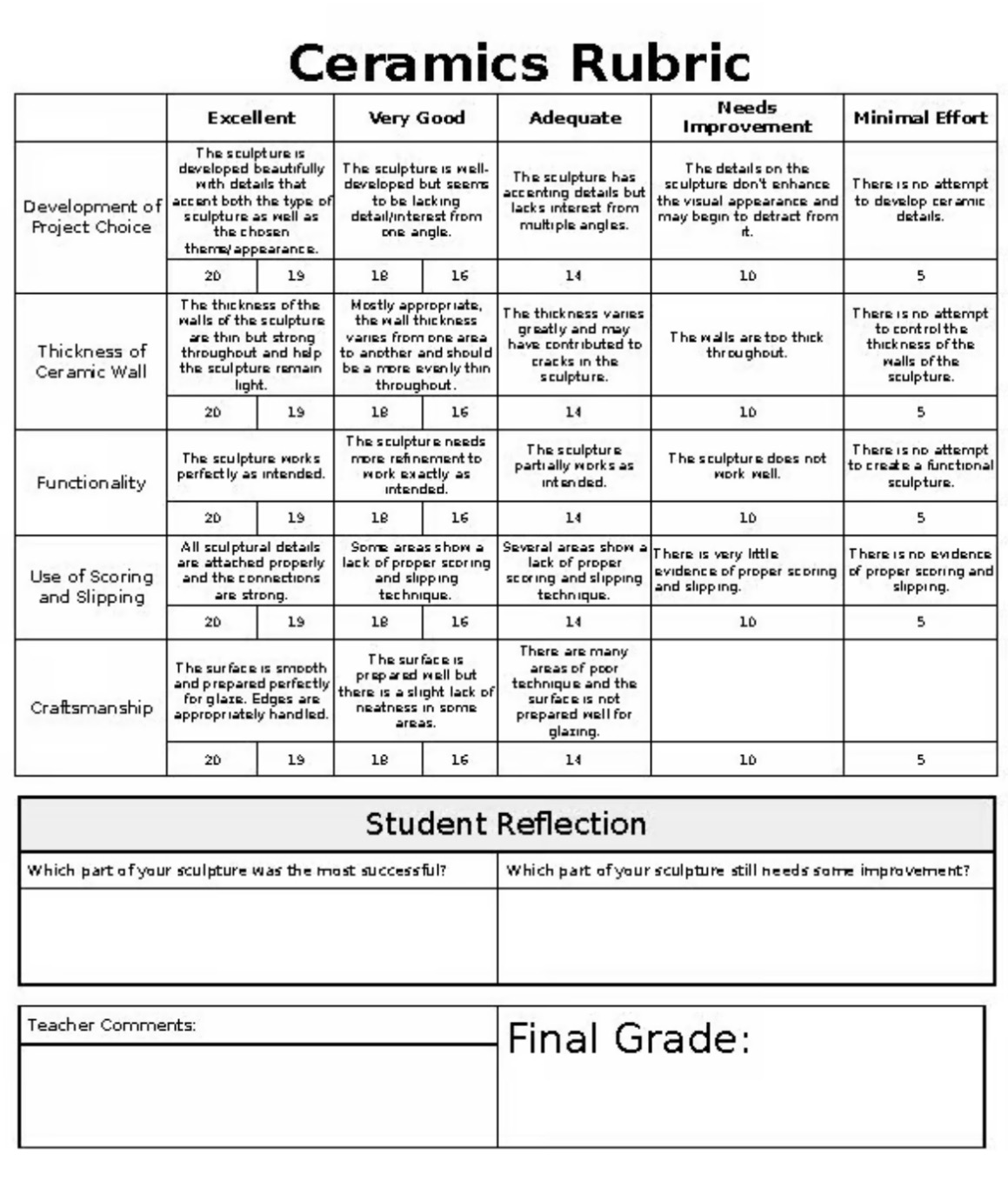
Your Google Classroom Topics tab links presentation images and reels that introduce students to the objectives, and ultimately the process steps including original student work. 1. Engagement Hook Students watch the reel: What is Steampunk? Fiction to subculture/Explained for the curious https://youtu.be/EGgs66Q4dDs?si=7QRSfRv0Eyz193Ur 2. Take aways: Steampunk is an imagined alternative style that originated in the 1980’s pop culture. A sub-genre of science fiction, it features a retro-post apocalyptic aesthetic focused on visible mechanical parts like cogs, gears, chains, pipes, and gaskets. Inventions are blended from the Victorian and1800’s industrial revolution “steam powered” eras. The style contrasts with modern technology where components are hidden and avoids any use of plastics or sleek technology. • Typical colors: Earthtone brown, deep yellow, warm metallic copper, and dark iron • Characteristics: Distressed (oxidized), gritty, industrial machinery blended with Victorian accessories (brocade leather, lace, and velvet) Note: I limit the overuse of the textile accessories 3. Presentation reviews stylistic images and RUBRIC expectations
Studio Expectations
Introduction of clay tools, clay storage and clean-up procedures 1. Demonstration: Finding and/or making a form suitable for the project • Plastic forms must be wrapped in newsprint. • Wrapping newsprint with masking tape to form an original slump mold for draping clay. 2. Student hands-on work production
Making your Steampunk Form (3 class periods)
1. Demonstrate the following: • How to roll out your clay, making a slab with even thickness • Strip cutting and secure attachment methods “score, slip, attach and smooth.” 2. Student hands-on work production
Adding pattern and texture and making a base or foot (1 class)
Demonstrate the difference between making additive and subtractive designs 1. Choose your stamps. 2. Using cornstarch to limit sticking. 3. Using plastic so tools do not get clogged. Demonstrate making a foot and or a base 1. 2 “Cookie” cutters 2. Coil and Sphere 3. Using your pot as a template for a custom base
Bisque Fire-
Finished work must dry out slowly until bone dry Fire according to directions depending on the type of clay.
Final Steps: Applying a cold finish.
Painting instead of glaze is a great way of finishing a piece at the end of a semester. A metallic effect is desired. 1. Watercolor Paint- Limit students to a Steampunk palette option. Keep students to 1-2 color choices. Any watercolor paint that you have on hand will work just fine. I recommend watercolor because it maintains a translucent effect. There is liquid metallic watercolor paint available, but not necessary. Mist with an aerosol matte clear coat to seal if desired.Demonstrate • apply 1-2 colors of paint using the following tools: • brush • sponge and wipe away to accentuate textures.Warning: stay away from acrylic paint. Beginning students apply acrylic too thickly and it can’t be wiped away due to the porous clay body. They may confuse acrylic paint with glaze later (this is problematic in a multiuse classroom.)2. Metallic spray paint (optional)- A spray booth recommended. • Clearly demonstrate how to lightly mist the bisqueware. • Supervise older students closely with metallic spray paint. • No spray booth? Locate an area somewhere far away from cars and structures. • Set up a drop cloth out of doors after checking wind direction.
Additional Documents
Follow Us: